
Where Undergraduates Become Scholars
Story By: Jeanette Budding and Mary Pautsch | Photography By: Gabby Petruzzello ’24 and Megan Muur Boline ’23
November 17, 2026
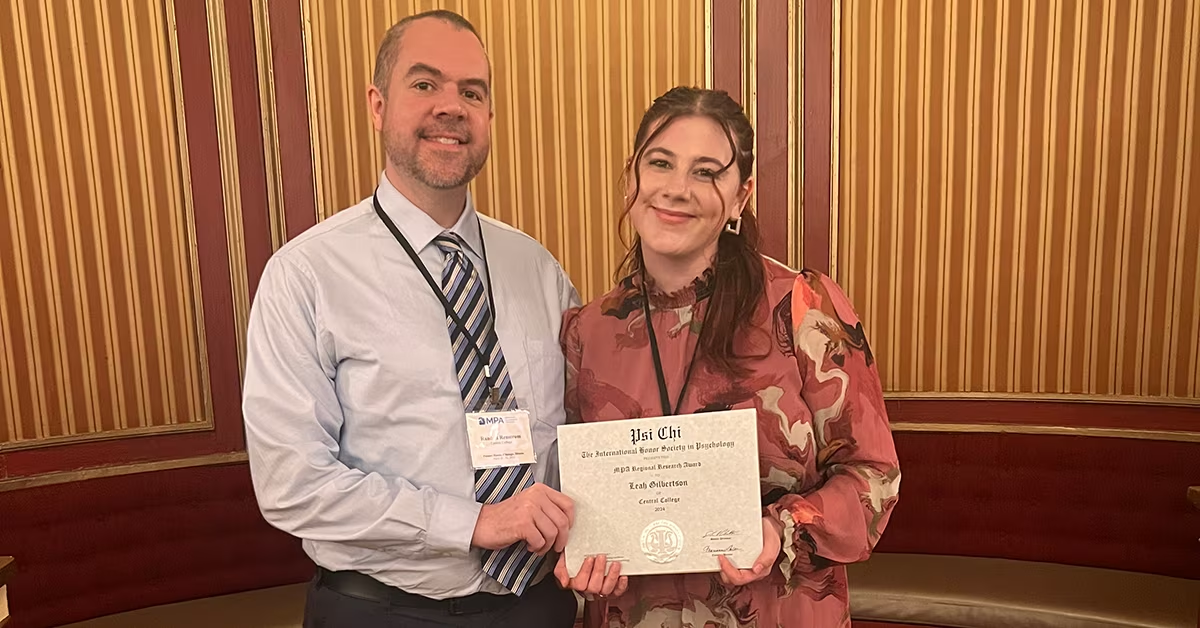
Leah Gilbertson ’24 explored how people build a sense of pride around disability identity and earned a Psi Chi Research Award. Randall Renstrom helped recognize Gilbertson at the Midwestern Psychological Association in Chicago.
All of us strive to be recognized for the work we do. A “good job” from a colleague, a congratulatory company-wide email or even just a thumbs up emoji from your boss in the Microsoft Teams chat can be enough of a boost.
But to be really recognized, like with an award or publication from a major network of your peers — that can be a major milestone that takes years of dedication.
Yet, psychology students at Central College are doing that year after year, before they even enter the workforce. What may be the peak of some careers is just the tip of the iceberg for Central undergraduates.
MAKING A REAL IMPACT
“They often tell us that they did more than they thought they could, or they accomplished more than they ever thought that they would be able to,” says Randall Renstrom, professor of psychology and chair of the behavioral sciences department. “What they did was be recognized as professional researchers at the Midwestern Psychological Association conference.”
“The success rate of Central students’ projects being accepted for presentation is quite impressive,” Renstrom says. “The psychology program began including empirical research projects in Experimental Psychology in 2011. Since then, 61 of the 62 projects submitted for presentation have been accepted via blind review.”
Even more striking, Central undergraduates routinely earn a spot in MPA’s professional-level program, presenting alongside graduate students, PhD candidates and faculty who have no idea, until they read the name tag, that they’re talking to a junior or senior, Renstrom explains.
“What’s exceptional about us is the quality of the research the students are doing,” Renstrom says. “Our size allows us to do psychology and not just learn about psychology.”
That philosophy, embedded in the department’s curriculum since the late 1990s under emeritus faculty member Ed Willis, has become one of Central’s quiet signatures. Many psychology majors culminate their studies with an advanced class where they design and carry out their own original research, often working side by side with a faculty mentor as a genuine research partner rather than an assistant.
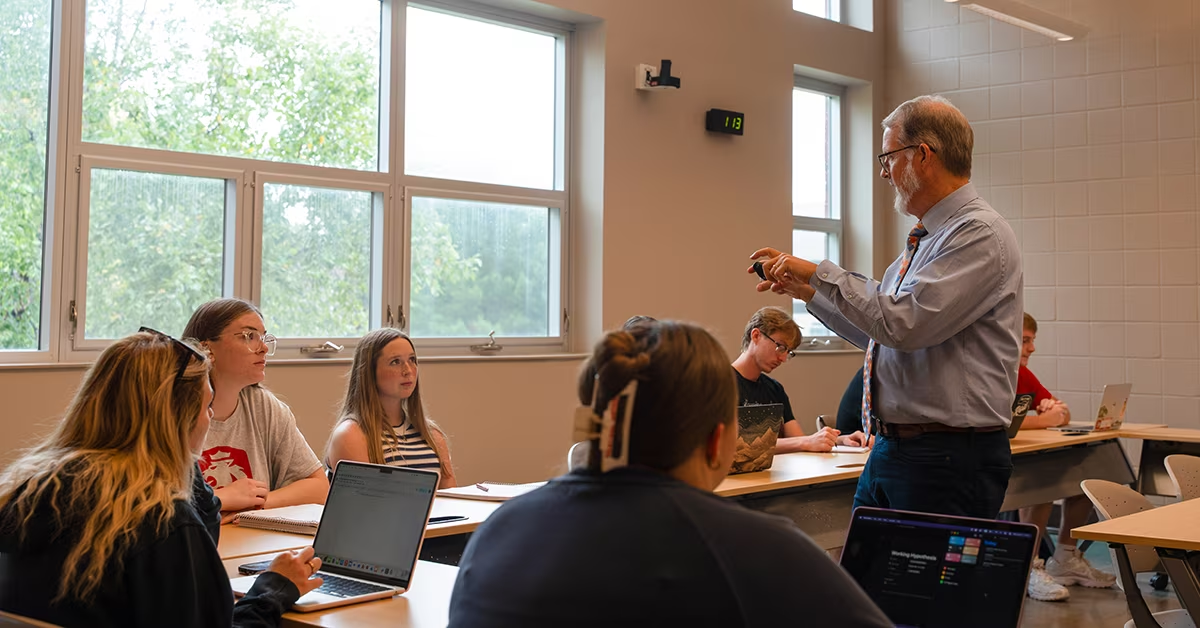
A Central alumni survey revealed 60% of Central psychology majors earn a master’s degree and 15% earn a doctorate-level degree, both ahead of the trend reported by the APA in 2019.
STUDENT SUCCESSES
It leads to some unique, award-winning studies. Andie Leeper ’20, who studied perceptions of sexism against women in STEM, was a Psi Chi Research Award winner, and went on to become a practicing counselor. Leah Gilbertson ’24 explored how people build a sense of pride around disability identity and also earned the Psi Chi Research Award. Shelby DeMeulenaere ’13, in one of the department’s earliest standout projects, researched post-traumatic growth and later earned a master’s degree at Bangor University in Wales — where she still lives today.
“What’s greatest for me is just seeing the kind of bubble around students break,” Renstrom says. “They start to see, ‘Oh, I’m actually above a lot of these other schools,’ or ‘I’m doing things that other students aren’t.’ But it’s not really until they get to the MPA conference that they realize that.”
MPA is also a launchpad for future opportunities. Renstrom has seen students get scouted by faculty at other institutions for graduate programs after seeing the work they can do.
Central psychology graduates go to graduate school at rates well above the national average for private colleges, into fields ranging from clinical psychology to law, social work and physical therapy — each one carrying the confidence of having already stood in a conference hall and shared their discoveries.
Funding from the Ed Willis Endowment, the De Cook Endowment for Character and Leadership and the Bette Brunsting ’56 Student Project Fund help cover the cost of the trip, ensuring the experience remains accessible to students regardless of financial means. You can contribute to these funds and help ensure students get the chance to show off how Central teaches success.
WANT TO SEE THIS ISSUE IN PRINT?
Click the cover to see this issue in our new online print viewer!